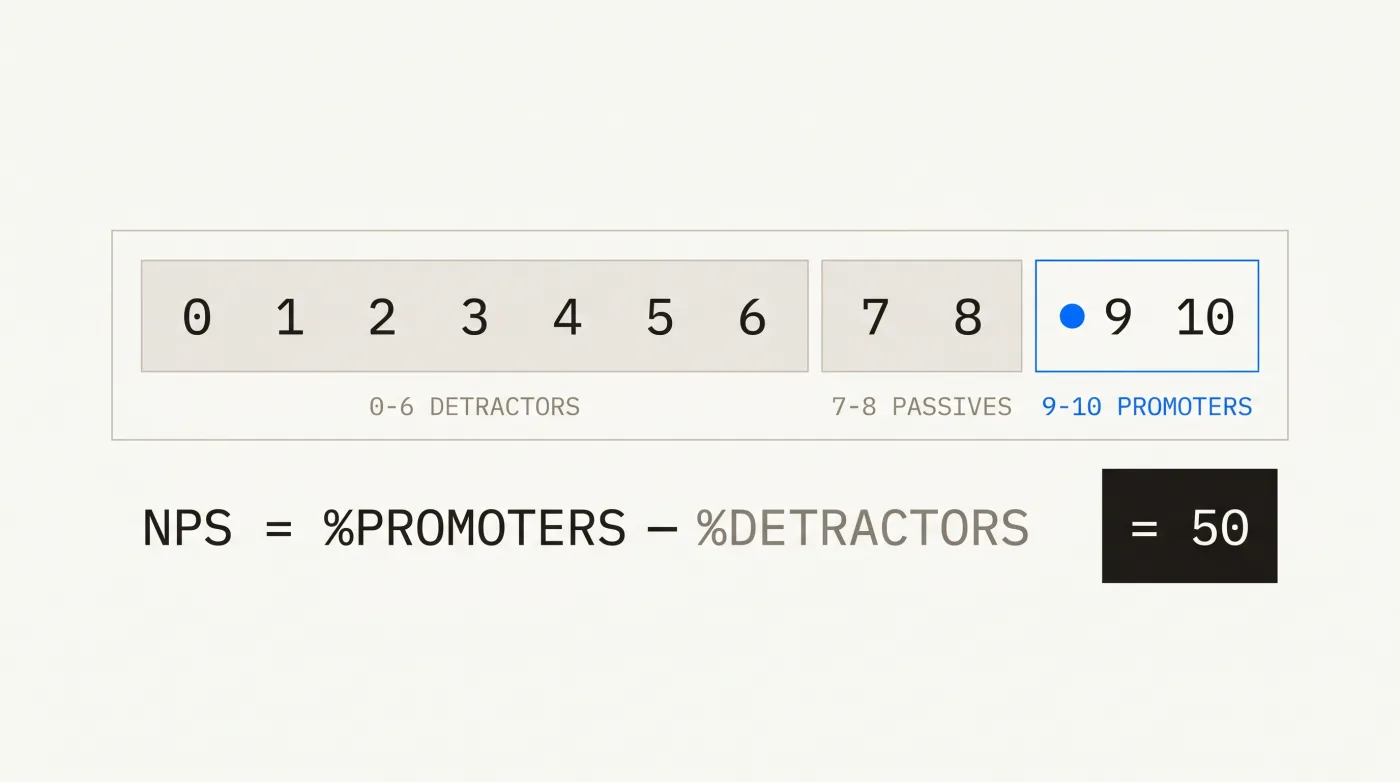
How NPS works
Respondents are grouped by their 0-10 answer: promoters (9-10) are loyal enthusiasts, passives (7-8) are satisfied but unenthusiastic, and detractors (0-6) are at risk of churning or spreading negative word of mouth. NPS is the promoter percentage minus the detractor percentage, so passives count toward the total but not the score.
What's a good NPS?
Anything above 0 means you have more promoters than detractors. Above 30 is good, above 50 is excellent, and above 70 is world-class — but benchmarks vary widely by industry, so compare against your sector and your own trend rather than a universal bar.
How support moves NPS
NPS reflects the whole relationship, but support is one of its strongest levers: fast, accurate, low-effort help turns at-risk detractors into passives and passives into promoters over time. Pair NPS with the follow-up question "What's the main reason for your score?" to learn exactly what to fix.
Formula
NPS = % Promoters (9-10) − % Detractors (0-6)
Example: If 60% of respondents are promoters and 10% are detractors, NPS = 60 − 10 = 50.